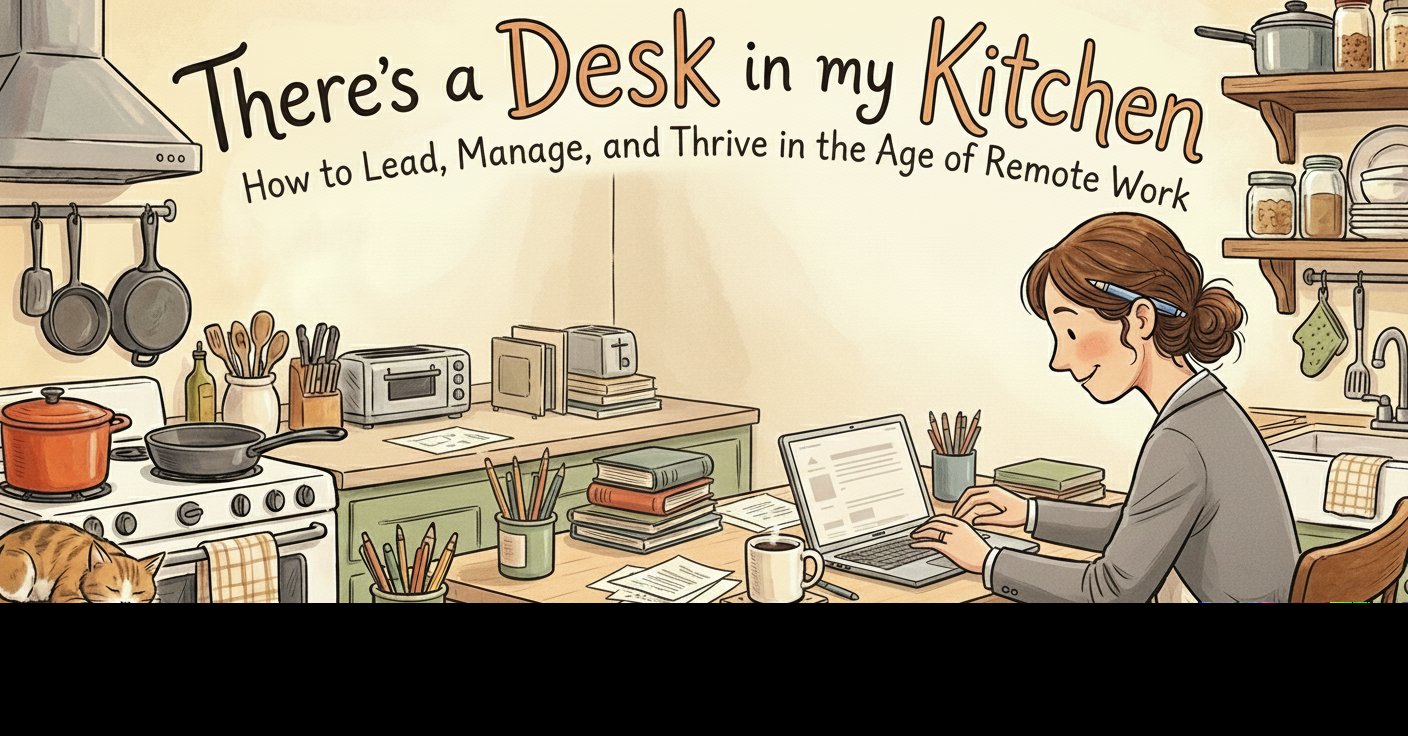
There's a Desk in My Kitchen

How to Lead, Manage, and Thrive in the Age of Remote Work

Remote work is a double-edged sword. This book shows you how to wield it with intention—maximising its benefits while managing its risks.

Buy on Amazon Explore the ADAPT Framework
There's a Desk in My Kitchen - Book Cover

About the Book

A comprehensive, research-backed guide to making remote and hybrid work succeed

Remote work is now permanent, yet most organisations are still getting it wrong. The debate remains polarised—enthusiasts versus sceptics—while leaders caught in the middle get no practical guidance.

This book fills that gap. Drawing on research from Stanford, MIT, Harvard, Gallup, and McKinsey, it examines what actually works—and what doesn't—across every dimension of distributed work: organisational strategy, employee wellbeing, digital tools, equity and inclusion, legal compliance, culture, and leadership.

📊

Research-Backed

Built on evidence from leading institutions, not opinions or anecdotes

🔧

Practical Tools

Policy templates, checklists, and frameworks you can use immediately

⚖️

Balanced View

Honest about both benefits and challenges—no ideology, just what works

The ADAPT Framework

A cyclical approach to implementing and continuously improving remote work

A

Analyse

Where are we now?

D

Design

What will we build?

A

Activate

How do we launch?

P

Probe

Is it working?

T

Transform

What needs to change?

The cycle is continuous—Transform leads back to Analyse. Organisations never 'finish' ADAPT; they mature through repeated cycles, each building on the last.

What's Inside

Ten chapters covering every dimension of remote work

1

The Double-Edged Sword

How remote work reshapes organisations—benefits, challenges, and the strategic choice

2

Freedom and Fragmentation

The lived experience of remote work—liberation, isolation, and everything between

3

The Digital Workshop

Tools, productivity, and the friction that undermines effectiveness

4

A Tuesday in Five Lives

Equity and inclusion—how remote work affects different people differently

5

The Legal Labyrinth

Employment law, tax, data privacy, and compliance across jurisdictions

6

The Invisible Architecture

Building and sustaining culture when people no longer share physical space

7

The New Leadership Mandate

Why remote leadership is fundamentally different—and what it demands

8

Leading from Anywhere

The practical playbook—communication, feedback, performance, and team cohesion

9

The Implementation Roadmap

The ADAPT framework—a structured approach to making remote work succeed

10

The Road Ahead

The future of work—forces, tensions, and the choices that remain

About the Author

Written by someone who's lived it

Mike Wintle

Mike Wintle

For many years, I have enjoyed the privilege of working remotely and have also had the honour of leading a remote team spanning from the UK across Europe and reaching as far as Australia and India. When the pandemic struck, my team and I simply continued what we were doing—and we managed to make it work successfully for years. It was, therefore, surprising to see that other departments and individuals were struggling.

Having completed my MBA in 2019, I always felt a strong desire to pursue further studies. After the pandemic began and I observed teams, departments, and even entire companies succeed with remote work—as well as those that failed—I became curious about the factors that contributed to success or failure. This curiosity sparked my research journey, even without being enrolled in an academic programme.

I believe that remote and hybrid work, when thoughtfully designed, can make organisations more effective and enrich people's lives. I have experienced this and seen it work well. The key difference, in nearly every case, hinges on intentionality—whether leaders view distributed work as a strategic decision needing careful planning or as a passive default that can be left to organise itself.

This perspective guides my approach throughout this book. I am neither an uncritical advocate nor a sceptic by habit. I focus on what truly works, under what conditions, and why. My aim is to help leaders make better decisions—not by telling them what to choose, but by offering a clearer understanding of the options they face.

Get the ADAPT Toolkit Free

Download the complete implementation checklist, diagnostic questions, and quick-reference guides from the book.

No spam. Unsubscribe anytime.